
What Is Melamine Acoustic Foam? Uses in HVAC, Duct Silencers and Equipment Noise Control
Melamine acoustic foam is a lightweight, open-cell, non-fibrous sound absorbing foam made from melamine resin. It is used to reduce noise in HVAC duct silencers, industrial ventilation systems, acoustic panels, equipment enclosures, air inlet silencers and other engineered noise-control applications.
Unlike ordinary cleaning sponge or general-purpose foam, melamine acoustic foam is designed for applications where sound absorption, airflow performance, flame-retardant behavior, low weight and long-term material stability must be considered together.
For manufacturers of HVAC silencers, duct sound attenuators, air handling units, acoustic enclosures, ventilation systems and power equipment, melamine acoustic foam provides a clean and lightweight alternative to traditional fibrous sound absorbing materials.
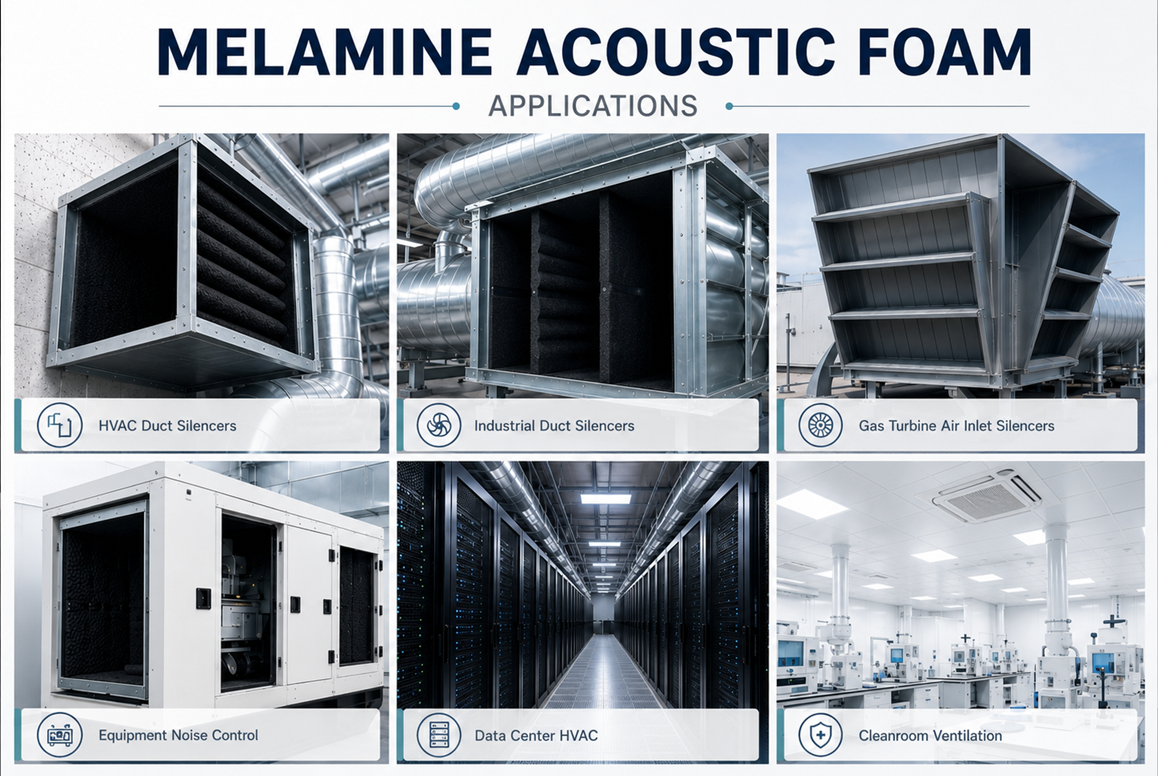
What Is Melamine Acoustic Foam?
Melamine acoustic foam is an open-cell foam material used to absorb sound energy. Its fine pore network allows sound waves to enter the foam, where air movement inside the pores creates friction and viscous loss. This process helps convert part of the acoustic energy into heat, reducing reflected noise and improving acoustic attenuation.
Because of its low density, open-cell structure and thermoset melamine chemistry, melamine acoustic foam is commonly used in applications that require lightweight sound absorption, flame-retardant performance and clean material handling.
Typical applications include:
HVAC duct silencers;
industrial duct silencers;
sound attenuators;
acoustic panels;
air inlet silencers;
fan and compressor enclosures;
generator canopies;
data center cooling equipment;
cleanroom and laboratory ventilation systems.
Is Melamine Foam Soundproof?
Melamine acoustic foam is mainly a sound absorbing material, not a complete soundproofing barrier.
This distinction is important.
Sound absorption means reducing reflected noise inside a space, duct or enclosure. Soundproofing means blocking sound transmission from one side of a structure to another.
Melamine acoustic foam helps absorb airborne noise by allowing sound waves to enter its open-cell structure. However, if a project needs to block noise transmission, the foam is usually combined with other materials such as perforated metal panels, steel sheets, aluminum housings, mass layers or composite acoustic structures.
In duct silencers and equipment enclosures, melamine acoustic foam often works as the sound absorbing core, while metal frames, perforated panels and enclosure structures provide mechanical protection and sound blocking support.
How Does Melamine Acoustic Foam Absorb Sound?
Melamine acoustic foam absorbs sound through its open-cell structure.
When sound waves enter the foam, air inside the interconnected pores begins to move. As this air moves through the narrow pore network, friction occurs between the air and the foam skeleton. This friction converts part of the sound energy into a small amount of heat.
This is why open-cell foam is widely used in acoustic systems.
For HVAC, duct silencers and industrial ventilation systems, the foam structure must allow sound to enter while still maintaining suitable resistance to airflow. If the foam is too open, sound may pass through too easily. If the foam is too resistant, sound may not enter the material effectively.
This is where airflow resistivity becomes important.

Why Airflow Resistivity Matters
Airflow resistivity is one of the key technical parameters for porous acoustic materials. It measures how much resistance air experiences when passing through the material.
For acoustic foam, airflow resistivity is important because it reflects the relationship between pore structure, air movement and sound absorption performance.
If airflow resistivity is too low, the material may not provide enough acoustic damping. If airflow resistivity is too high, sound waves may not penetrate deeply into the foam. A controlled airflow resistivity range helps balance acoustic absorption and air passage.
For engineered acoustic applications, airflow resistivity may be tested according to ASTM C522 or similar methods. In industrial silencer specifications, this type of testing helps verify whether the foam has a suitable open-cell structure for duct silencers, air inlet silencers and equipment noise-control systems.
In one industrial gas turbine air inlet duct specification, melamine foam is described as a sound absorbing material for acoustic cushions, with airflow resistivity specified at 10,000–30,000 MKS Rayls/m when tested according to ASTM C522. The same specification also includes requirements related to density, flame behavior, water retention, putridity and corrosivity. This shows that high-end acoustic applications evaluate melamine foam as an engineered material, not only as a lightweight foam.
Key Benefits of Melamine Acoustic Foam
- Lightweight Sound Absorbing Material
Melamine acoustic foam has a very low density compared with many traditional insulation and acoustic materials. This makes it suitable for large duct silencers, suspended acoustic panels, air inlet systems, equipment enclosures and modular noise-control structures.
A lightweight acoustic core can reduce the load on metal frames, duct systems and equipment housings.
For industrial silencer panels, lightweight material design can also simplify fabrication, installation and maintenance.
- Open-Cell Acoustic Structure
The open-cell network of melamine foam helps absorb mid- and high-frequency noise generated by airflow, fans, compressors, pumps, turbines and mechanical equipment.
This makes melamine acoustic foam suitable for:
HVAC duct silencers;
industrial ventilation silencers;
fan inlet and outlet silencers;
compressor enclosures;
generator canopies;
air inlet acoustic panels.
- Non-Fibrous Material
Many duct silencers and acoustic panels traditionally use glass wool, rock wool or mineral wool. These materials are widely used and cost-effective, but some applications require cleaner, non-fibrous materials.
Melamine acoustic foam is a non-fibrous foam. It does not rely on loose fibers for sound absorption.
This can be useful where customers are concerned about:
fiber dust release;
clean air paths;
sensitive equipment environments;
handling comfort;
HVAC systems connected to occupied spaces;
cleanroom or laboratory ventilation.
For data centers, hospitals, laboratories and clean air systems, the non-fibrous structure of melamine acoustic foam can be an important advantage.
- Flame-Retardant Behavior
Melamine foam is based on thermoset melamine resin chemistry and is known for good flame-retardant behavior.
For HVAC systems, duct silencers, industrial ventilation systems, generator enclosures and power equipment noise-control applications, fire behavior is often an important part of material selection.
Depending on project requirements, customers may request relevant flame-retardant test reports, such as UL 94, EN 13501-1, ASTM E84 or other regional standards.
When writing specifications, customers should confirm the required fire standard according to the final application, installation location and local building or industrial safety requirements.
- Low Water Retention for Air-Handling Systems
In HVAC ducts, air inlet systems and industrial ventilation environments, acoustic materials may be exposed to humidity, condensation, wet air or outdoor air intake conditions.
A suitable acoustic foam should not retain excessive water.
Low water retention helps reduce:
weight increase;
loss of acoustic performance;
long-term moisture accumulation;
risk of odor or material degradation;
corrosion risk in nearby metal structures.
For air inlet silencers, ventilation silencers and outdoor-connected duct systems, water retention performance can be an important selection factor.
- Easy Fabrication and Custom Cutting
Melamine acoustic foam can be supplied in blocks, sheets or custom-cut parts.
It can be processed into:
flat sheets;
baffle inserts;
duct silencer fillings;
perforated panel cores;
equipment enclosure linings;
CNC-cut acoustic parts;
adhesive-backed components upon request.
This makes it suitable for integration into metal acoustic systems, aluminum frames, galvanized steel duct silencers and customized equipment enclosures.
Main Uses of Melamine Acoustic Foam
- HVAC Duct Silencers and Sound Attenuators
HVAC duct silencers are used to reduce noise from fans, air handling units and air movement inside building ventilation systems.
They are commonly used in:
office buildings;
hotels;
hospitals;
schools;
airports;
shopping malls;
conference centers;
metro stations;
commercial buildings.
In HVAC systems, the acoustic material is usually installed inside a metal sound attenuator, behind perforated metal sheets or inside splitter baffles.
For HVAC air paths connected to occupied spaces, low-formaldehyde or low-emission melamine acoustic foam is recommended. In these applications, sound absorption should be considered together with indoor air quality, low odor and clean air path requirements.
- Industrial Ventilation and Duct Silencer Panels
Industrial duct silencers are used in factories, power plants, boiler rooms, pump stations, compressor rooms and process ventilation systems.
These systems often need to reduce noise from:
large fans;
high-speed airflow;
industrial exhaust systems;
air intake ducts;
process ventilation systems;
mechanical equipment rooms.
Melamine acoustic foam can be used as a lightweight, non-fibrous sound absorbing core inside industrial duct silencer panels.
For enclosed industrial applications where air does not enter occupied indoor spaces, industrial acoustic-grade melamine foam may be selected. The key focus is usually airflow resistivity, flame behavior, density, water retention, dimensional stability and long-term performance.
- Gas Turbine Air Inlet Silencers
Gas turbine air inlet systems require large volumes of air to pass through while also reducing noise generated by airflow and turbine operation.
In this type of application, acoustic cushions or silencer panels may be installed inside air inlet ducts to improve acoustic attenuation.
Melamine acoustic foam can be used as a lightweight, open-cell sound absorbing material for air inlet duct silencer panels. Important selection factors may include:
low density;
controlled airflow resistivity;
flame-retardant behavior;
low water retention;
non-corrosive performance;
non-putrid behavior;
long-term stability inside metal duct systems.
This is one of the highest-value industrial applications for acoustic-grade melamine foam. It also shows why professional customers evaluate not only the foam thickness and density, but also airflow resistivity and other engineering parameters.
- Equipment Noise Control Enclosures
Industrial equipment often requires acoustic lining inside metal enclosures, protective housings or machine covers.
Examples include:
compressor enclosures;
pump room acoustic panels;
fan housings;
generator canopies;
industrial control cabinets;
machine covers;
mechanical equipment rooms.
In these systems, melamine acoustic foam can be installed behind perforated metal sheets or inside enclosure walls to absorb internal reflected noise.
For equipment installed in fully industrial environments, standard industrial acoustic grades may be suitable. For equipment located in hospitals, schools, commercial buildings, laboratories or indoor occupied spaces, low-emission grades are recommended.
- Data Center HVAC and Cooling Equipment Noise Control
Data centers use large cooling systems, fans, air handling units, cooling towers and backup generators. These systems can create significant noise.
At the same time, data centers are sensitive environments where dust, fibers and material emissions should be controlled.
Low-emission, non-fibrous melamine acoustic foam can be considered for:
data center HVAC silencers;
air handling units;
cooling equipment noise control;
generator enclosure lining;
equipment room acoustic treatment;
ventilation noise-control panels.
For mission-critical cooling systems, the value of melamine acoustic foam is not only sound absorption. Its lightweight, non-fibrous and clean material characteristics can also support the reliability needs of sensitive equipment environments.
- Cleanroom, Hospital and Laboratory Air Systems
Cleanrooms, hospitals and laboratories often require ventilation systems that control both noise and air quality.
In these environments, acoustic materials should reduce noise without introducing unnecessary fiber dust, odor or emissions into the air path.
Low-formaldehyde or low-emission melamine acoustic foam may be suitable for:
cleanroom HVAC duct silencers;
hospital ventilation systems;
laboratory supply and exhaust air systems;
pharmaceutical clean air systems;
electronics manufacturing air handling systems;
food processing clean air environments.
For these applications, low-emission grades should be selected instead of ordinary industrial acoustic grades.
- Interior Acoustic Panels and Occupied Spaces
Melamine acoustic foam may also be used in interior acoustic panels, ceiling absorbers, wall panels, meeting rooms, classrooms, studios and public buildings.
For these applications, the foam may be exposed to indoor air for long periods and may be closer to people. Therefore, low-formaldehyde, low-odor and low-emission grades are strongly recommended.
For interior acoustic systems, customers should also consider surface covering materials, fire rating, dust control, installation method and local building code requirements.
Industrial Acoustic Melamine Foam vs Standard Acoustic Foam
Industrial acoustic melamine foam is a specialized grade selected for duct silencers, ventilation systems, power equipment and equipment noise-control applications.
Compared with general acoustic foam, industrial acoustic melamine foam usually places more emphasis on:
airflow resistivity;
flame-retardant behavior;
low water retention;
dimensional stability;
non-corrosive performance;
long-term use inside metal systems;
compatibility with perforated panels and duct structures.
General acoustic foam may be suitable for light indoor sound absorption, but industrial systems often need a more engineering-focused material specification.
For example, a duct silencer manufacturer may need to know whether the foam can work inside a metal baffle structure. A gas turbine air inlet system supplier may need airflow resistivity and water retention data. A cleanroom HVAC contractor may need low-emission and non-fibrous material performance.
This is why SINOYQX separates acoustic foam selection by application environment rather than offering only one general-purpose foam grade.
When Should Low-Formaldehyde Melamine Acoustic Foam Be Used?
Low-formaldehyde melamine acoustic foam should be considered when the material is used in applications related to occupied spaces, indoor air paths or direct human exposure.
A simple selection rule is:
If the foam is enclosed inside industrial equipment and air does not enter occupied spaces, industrial acoustic grade may be suitable.
If air passes over the foam and enters a room where people work, study, live or receive medical care, low-emission HVAC acoustic grade is recommended.
If the foam is exposed indoors, used in acoustic panels, installed near occupants or used in consumer applications, low-formaldehyde grade should be prioritized.
Recommended Grade by Application
| Application | Human Contact Level | Recommended Grade |
| Gas turbine air inlet silencer | No direct contact | Industrial acoustic grade |
| Power plant duct silencer | No direct contact | Industrial acoustic grade |
| Industrial exhaust duct | No direct contact | Industrial acoustic grade |
| Compressor enclosure | Limited maintenance contact | Industrial acoustic grade |
| Commercial HVAC duct silencer | Indirect air-path exposure | Low-emission HVAC acoustic grade |
| Hospital or school HVAC system | Indirect air-path exposure | Low-formaldehyde HVAC acoustic grade |
| Data center cooling air path | Indirect sensitive environment | Low-emission clean acoustic grade |
| Cleanroom or laboratory ventilation | Indirect sensitive air path | Low-emission clean acoustic grade |
| Interior acoustic panel | Long-term indoor exposure | Low-formaldehyde interior grade |
| Vehicle interior acoustic part | Close occupant exposure | Low-formaldehyde low-VOC grade |
| Consumer or cleaning sponge application | Direct contact | Low-formaldehyde / low-migration grade |
Melamine Acoustic Foam vs Glass Wool
Glass wool, rock wool and mineral wool are widely used in duct silencers and building acoustic applications. They are cost-effective and familiar to the market.
However, melamine acoustic foam can offer advantages in applications where customers need a cleaner, lighter or non-fibrous material.
Comparison Overview
| Item | Melamine Acoustic Foam | Glass Wool / Mineral Wool |
| Structure | Open-cell non-fibrous foam | Fibrous material |
| Weight | Very lightweight | Usually heavier depending on density |
| Dust / fiber concern | Lower fiber dust concern | Fiber release may need control layers |
| Fire behavior | Good flame-retardant behavior depending on grade | Often good, depending on binder and facing |
| Clean air applications | Suitable for selected low-emission grades | Requires careful facing and sealing |
| Processing | Easy to cut and shape | Easy to cut but may need protective handling |
| Cost | Usually higher | Usually lower |
| Best fit | High-value acoustic, HVAC, clean air and equipment applications | Cost-sensitive general duct and building applications |
The best material choice depends on acoustic target, budget, fire requirements, air quality requirements, installation method and maintenance conditions.
For low-cost general construction applications, glass wool or mineral wool may still be suitable. For high-value duct silencers, clean HVAC systems, data centers, laboratories, sensitive equipment rooms and non-fibrous acoustic solutions, melamine acoustic foam can be a strong alternative.
What Technical Data Should Customers Check?
When selecting melamine acoustic foam, customers should not only ask for thickness and density. A complete material evaluation may include:
material type;
density;
thickness;
airflow resistivity;
sound absorption coefficient;
flame behavior;
water retention;
temperature resistance;
formaldehyde or VOC data when required;
corrosivity;
dimensional tolerance;
cutting and installation method.
For duct silencers and industrial acoustic systems, airflow resistivity is especially important because it directly relates to how air and sound interact with the porous material.
For HVAC and occupied-space applications, low-emission performance should also be considered.
For public buildings, transportation, cleanrooms, laboratories and data centers, customers may also need additional tests according to local regulations or project specifications.
Why Choose SINOYQX Melamine Acoustic Foam?
SINOYQX supplies melamine foam materials for acoustic, insulation, cleaning and specialty industrial applications.
For acoustic systems, SINOYQX can support customers with open-cell melamine acoustic foam designed for:
HVAC duct silencers;
industrial ventilation silencers;
air inlet acoustic panels;
equipment noise-control enclosures;
data center HVAC noise control;
cleanroom and laboratory ventilation systems;
custom acoustic panel fabrication.
Available options may include:
industrial acoustic-grade melamine foam;
low-emission HVAC acoustic grade;
low-formaldehyde grade for indoor or human-contact applications;
foam blocks for further fabrication;
custom-cut sheets and panels;
CNC-cut acoustic parts;
sample support for acoustic testing and product development.
SINOYQX can help customers select the right melamine acoustic foam grade according to application environment, air path, human contact level, flame-retardant requirement and acoustic performance target.
Frequently Asked Questions
What is melamine acoustic foam?
Melamine acoustic foam is a lightweight, open-cell, non-fibrous sound absorbing foam made from melamine resin. It is used in acoustic panels, HVAC duct silencers, industrial ventilation systems, equipment enclosures and air inlet silencer applications.
Is melamine foam soundproof?
Melamine foam is mainly sound absorbing, not fully soundproof by itself. It helps reduce reflected noise and improve acoustic attenuation, but sound blocking usually requires additional mass layers, metal panels or composite structures.
What is melamine acoustic foam used for?
Melamine acoustic foam is used for HVAC duct silencers, industrial duct silencers, air handling units, equipment enclosures, generator canopies, compressor housings, gas turbine air inlet silencers, data center cooling systems and interior acoustic panels.
Is melamine acoustic foam better than polyurethane acoustic foam?
It depends on the application. Melamine acoustic foam offers advantages in lightweight sound absorption, flame-retardant behavior, heat resistance and non-fibrous performance. Polyurethane foam may be more cost-effective for some general indoor acoustic uses, but it may not meet the same requirements for high-temperature, flame-retardant or industrial applications.
When should low-formaldehyde melamine acoustic foam be used?
Low-formaldehyde melamine acoustic foam should be used when the material is installed in HVAC air paths connected to occupied spaces, hospitals, schools, cleanrooms, laboratories, interior acoustic panels, vehicles, appliances or applications close to human contact.
Can melamine acoustic foam replace glass wool in duct silencers?
In some applications, yes. Melamine acoustic foam can be used as a non-fibrous alternative in duct silencers and HVAC sound attenuators, especially where lightweight, clean handling, low dust and low-emission performance are important. However, the final material choice should depend on acoustic target, cost, fire rating and project requirements.
Conclusion
Melamine acoustic foam is more than a lightweight foam material. It is an engineered sound absorbing solution for HVAC duct silencers, industrial ventilation systems, gas turbine air inlet silencers, data center cooling systems, equipment enclosures and interior acoustic panels.
Its open-cell structure, lightweight density, non-fibrous form, flame-retardant behavior and controllable airflow performance make it suitable for many high-value acoustic applications.
For enclosed industrial systems, industrial acoustic-grade melamine foam may be selected. For HVAC systems connected to occupied spaces, hospitals, schools, cleanrooms, laboratories and data centers, low-formaldehyde or low-emission grades are recommended.
As industrial customers and building system designers look for cleaner, lighter and more specialized acoustic materials, melamine acoustic foam offers a strong solution for the next generation of duct silencer, HVAC and equipment noise-control systems.