
Why More Power Equipment Manufacturers Are Switching to Melamine Foam Insulation
📈 The Shift Toward Advanced Materials Has Begun—Who’s Leading the Change?
Driven by global carbon neutrality goals and the increasing demand for safety and performance, the power equipment manufacturing industry is undergoing a material revolution. Traditional insulation materials such as EVA, PU and EPDM remain in use across power equipment; material selection depends on the operating temperature, fire requirements, electrical duties, aging conditions and the exact formulation.
Melamine foam, with its inherent flame resistance, ultra-low smoke emission, excellent electrical insulation, and high thermal stability, is being evaluated for selected thermal and acoustic applications in power equipment; final suitability depends on grade-specific tests and system design. At the forefront of this transformation is SINOYQX, a trusted name in high-performance melamine foam innovation.
🔍 Policy & Standards: Safer, Greener Materials Are No Longer Optional
Global regulations and national standards are driving the transition toward safer, low-emission insulation materials:
✅ IMO Part 2 & Part 5: Require insulation materials for offshore power and marine systems to meet low smoke and low toxicity thresholds
✅ EN 45545-2: EU standard for railway applications requires multi-level (HL2/HL3) compliance with fire safety and smoke emission
✅ State Grid Green Procurement Guidelines (China): Recommend halogen-free, recyclable, and low-VOC materials
✅ Energy storage safety requirements: The applicable published standards and fire-engineering design criteria must be identified for each project. A material’s thermal resistance alone does not establish battery thermal-runaway containment.
🌿 In short: Without upgrading insulation materials, power systems risk non-compliance with the future of engineering and regulation.
⚙️ Performance Comparison: SINOYQX Melamine Foam vs. Traditional Materials
| Property | SINOYQX Melamine Foam | EVA / PU / EPDM Foam |
| Flame Resistance | Inherent, UL94 V-0 | Depends on the specific polymer formulation, additives and test conditions |
| Smoke Density (SDR) | < 30, compliant with IMO | Smoke performance varies by foam formulation and the relevant fire-test method |
| Surface Resistivity | ≥10¹⁸ Ω, excellent insulator | Electrical properties vary by grade, composition, conditioning and aging |
| Operating Temperature Range | -180°C to +240°C | Grade-specific operating temperatures must be confirmed by supplier data |
| Environmental Compliance | Low-formaldehyde, halogen-free, RoHS | Emission and restricted-substance performance depend on the tested grade |
| Service Life | ≥10 years, anti-aging | Service life depends on material selection, exposure and validation |
| Weight | 8.5 kg/m³, adjustable | Density and component weight vary with formulation and design |
| Recyclability | Physically recyclable, no heavy metals | Recycling and end-of-life routes depend on the material and local process |
🔋 Application Scenarios: From Switchgear to Energy Storage—The Foam Revolution
SINOYQX melamine foam is not just an insulator. It enables multi-functional performance for the next generation of electric power systems:
🔹 High-Voltage Switchgear
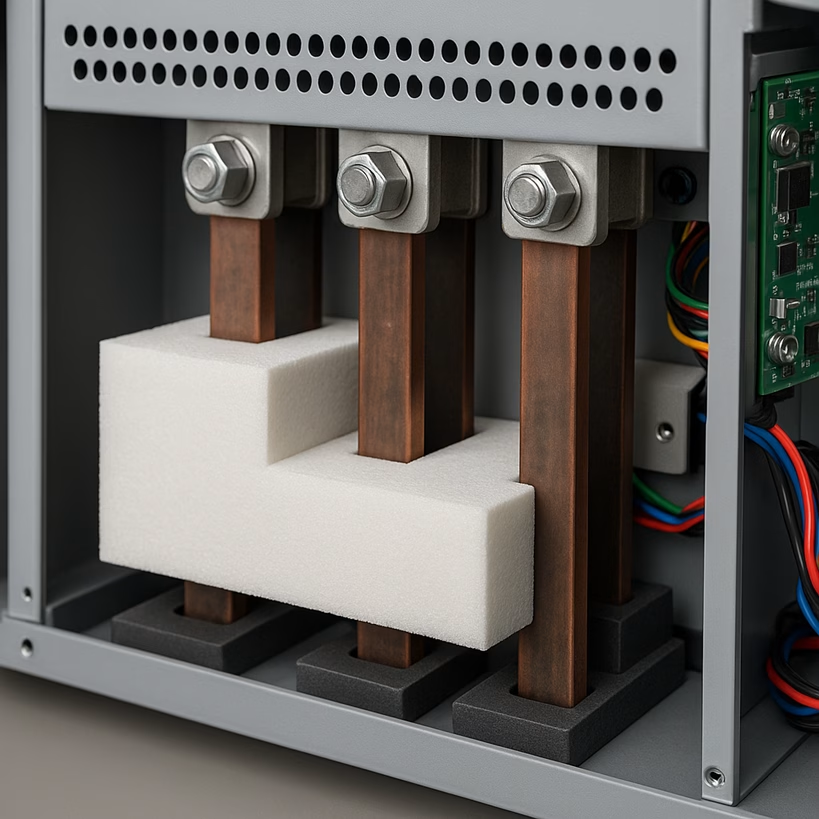
→ Potential use in acoustic fillers and selected electrically separated components requires clearance, dielectric withstand, fire-safety and OEM design approval. The foam must not be treated as an approved primary busbar insulation barrier without qualification.
🔹 Energy Storage Battery Modules
→ Can be evaluated for lightweight thermal and acoustic functions; electrical isolation and battery-level fire protection require qualification of the complete design.
🔹 Cable Trays / Capacitor Cabinets / Transformer Rooms
→ Can serve as an acoustic or thermal component where permitted by the equipment design; dielectric barrier duties and mechanical performance require relevant testing.
🔹 Rail & Marine Power Equipment
→ Rail and marine suitability must be verified against the applicable EN 45545-2 or IMO fire-test requirements for the selected grade and complete assembly; no blanket compliance claim is made.
🏭 Brand Power: SINOYQX—Engineered for Electrical Insulation Applications
At SINOYQX, we specialize in melamine foam materials engineered for electrical insulation and high-performance systems. Our advanced foam offers:
✅ Density Range: 8.5 kg/m³
✅ Surface Resistivity: Nominal material data are not evidence of a high-voltage insulation rating; test reports and system-level qualification are required
✅ Fire Rating: UL94 V-0, oxygen index ≥32%
✅ Smoke Density: Smoke test results and any marine compliance must be verified for the applicable grade and installed assembly
✅ Eco Compliance: RoHS status and formaldehyde emissions require applicable grade-specific test documentation
✅ Formats: Sheets, rolls, custom modules, die-cut parts
✅ Laminations Available: Aluminum foil, PET film, flame-retardant fabrics
Whether you’re building switchgear, energy storage cabinets or electrical enclosures, SINOYQX offers candidate materials whose safety and sustainability requirements must be checked against the intended system and application-specific evidence.
📣 Final Thought: Choosing Better Materials Is Choosing the Future
Melamine foam isn’t just a material upgrade—it’s a strategic engineering decision. With rising safety standards and sustainability benchmarks, SINOYQX melamine foam provides material options for lightweight acoustic and thermal components; any service-life, electrical-safety or regulatory claim must be demonstrated for the selected grade and complete system.
If your current materials are holding your systems back, now is the time to future-proof your design—with SINOYQX melamine foam.
📞 Request a Sample or Consultation:
SINOYQX
🌐 Website: www.sinoyqx.com
📧 Email: [email protected]
📱 Phone / WeChat: +86-13540702776